Research
The research behind ALS Forward.
The project that started ALS Forward uses computational biology to study ALS and PT150.
01 / The project

ALS · PT150
Computational research focused on PT150.
We used biological datasets, machine learning, model interpretation, and molecular docking to study PT150 as a possible ALS treatment.
- Recognition
- First place, Computational Biology & Bioinformatics, Regeneron ISEF 2025
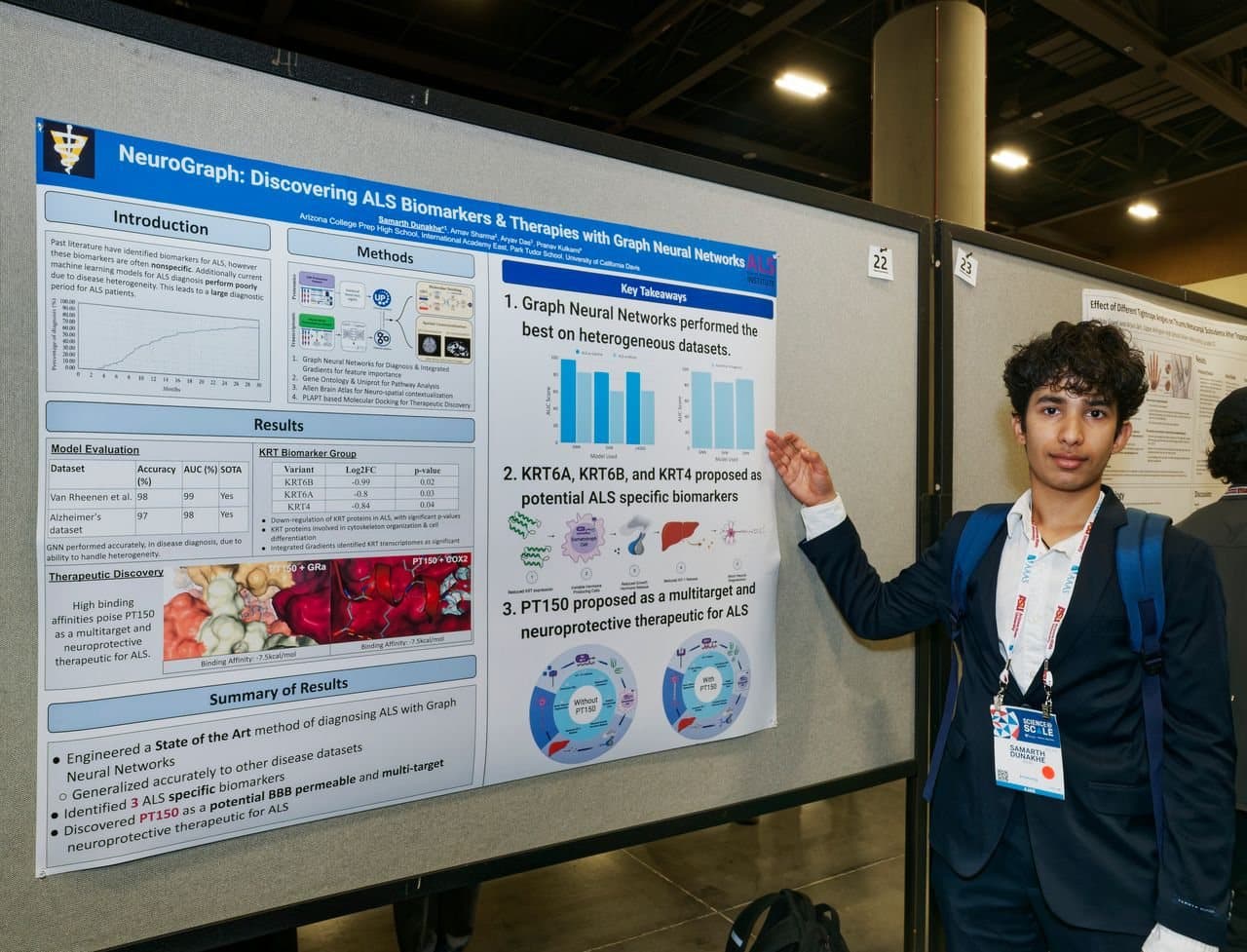
02 / What the team did
What we did.
Biological data analysis
Collected and analyzed public biological datasets related to ALS.
Graph neural network
Built a graph neural network to model molecular relationships in the data.
Model interpretation
Used interpretability tools to see what the model was learning.
Molecular docking
Ran molecular-docking simulations focused on PT150 in the context of ALS.
03 / Latest paper
A 3-gene panel that flags ALS dementia risk.
Some people with ALS also develop dementia, which changes the care they need. Using RNA sequencing from postmortem brain tissue, this paper finds three genes that separate ALS from ALS with dementia. A test based on them could flag that risk earlier and at low cost.
The biomarker panel
CXCL1 · RP11-264O24.2 · RP11-860L10.1
Three genes at 0.87 AUC. GPCR signaling was the main pathway that separated the two groups.
- Venue
- IEEE-EMBS International Conference on Biomedical & Health Informatics (BHI)
- Honor
- Selected as a Conference Spotlight
- Authors
- Samarth Dunakhe and Aryav Das
- Data
- GSE153960 postmortem frontal-cortex RNA-seq
82.93%
Best classifier accuracy (stacking random forest) separating ALS from ALS-dementia.
0.87 AUC
For the top three-gene panel, higher than the model that used every feature.
58 genes
Differentially expressed and enriched in GPCR signaling pathways.
1,606
Postmortem brain RNA-seq samples analyzed, focused on the frontal cortex.